Sunday, June 24, 2007

Khmer Rouge Soldiers, Too Much Fruit, and Confused Looking Children

This man was a Khmer Rouge soldier
.

This man marched into Phnom Penh on April 17th, 1975 and told people to evacuate to the countryside, precipitating one of the worst periods of systematic human rights abuses in recent history.

This man is a Buddhist monk.

Difficult to reconcile? We sure as hell thought so. How did we come to spend time with this singularly unique monk?

We (myself and BJ, my roommate) had decided to forego the warm sandy shores of Sihanoukville for the long weekend (being the Queen’s birthday and all of course). Instead, we traveled 5 hours North-East into a province called Kratie (pronounced Krah-cheh) with a co-worker of ours named Khamboly (Boly) Dy and another co-worker named Paree. This is the province that Boly grew up in, and he decided to go visit for the first time in over 2 years, in no small part due to the fact that he was about to move to the States to get a Masters degree.


Kratie has an interesting relationship to the Khmer Rouge, as it was both the first province overtaken by the KR forces, and then the first to fall. Thus, there are many former KR soldiers living in the area, and many of those who helped to overthrow them.


The drive out took us along National Road 4 (NR4) one of (X) number of national highways that sort of criss-cross the country. Considering that this is Cambodia, the road was in remarkable shape. That is, it was paved, wide enough for close to two cars to drive past each other, and had no land mines. Using your horn and steering are essentially the only two skills that you need to have in order to drive in Cambodia. Strategic use of the horn is a must, and there are a number of different and subtle techniques and sounds that you must be proficient in. For instance, if you are driving along a completely open road with no other cars on it, you will toot your horn every 15 seconds or so, to let anything (farmer, child, cow, pig, dog) know that you are coming. If there are other cars on the road, sometimes you will give several short blasts as they approach, apparently to let them know both visually and aurally that you are in fact, oncoming. Dealing with the thousands of motos is a challenge well suited to horn usage, as any time a moto is encountered (which is pretty much at all times) you are (it seems) required to honk at them until you have passed them by, just to make sure they know not to go veering into your lane.

Once you’re out on the open (ahem) road, the scenery unfolds to either side of you like an enormous shag carpet unrolling: sunken rice paddies with murky water and brilliant green shoots of new rice predominate the landscape, only occasionally broken up by a slender, palmy fronded tree standing alone among the fields. Slate gray, rib rippled cows meander about, nibbling here and fertilizing there. Along the road are dozens of wood and thatch shacks, effectively just covered platforms built a few feet off of the ground, intended to provide a little shelter for the workers and sometimes sell any of the many varieties of fruit available throughout Cambodia. Pulling the car over is like a siren song for long-sleeve clad women and children, heads covered in red and white checked scarves, to approach you with baskets full of bread, sticky-rice stuffed into bamboo, and fried spiders the size of your face. If you’re feeling bold (but not spider-eating bold) you can try some durian, the pungent fruit that is banned from public transport in most SEAsian countries due to its ummm…intoxicating scent (quite delicious though)
.

Another interesting feature of the landscape is the dichotomy between the shacks and huts that people call home, and the stupas and pagodas that reside right next to those shacks. The homes, for the most part, are neat wood structures, often 20-30 feet off the ground. They are supported at the base by concrete pylons and usually contain a small concrete patio on which may rest anything from a pack of dogs to enormous clay pots full of rainwater for cooking and cleaning.

The holy buildings, by contrast, are vast white, blue and gold structures, 4 stories high or more, with ornately accented edges and beautifully tiled roofs. The roof tiles are especially of note, as they are usually a pattern of blue, gold, green and red, and tend to be arranged in expanding concentric rectangles. All around the pagodas are individual stupas, large, painted concrete tombs into which the cremated ashes of loved ones are placed. Seeing these ornamental touches next to such humble homes gave me a moment of pause, trying to reconcile the vastly different priorities assigned in my own culture to the appearance of the home vs. that of where we bury our loved ones
.

A final architectural feature of note were the entrances to many of the rice paddies. I wasn’t sure exactly the divisions, but every few kilometers, there would be a narrow, dirt path inbetween the paddies that seemed to demarcate some sort of property line. Notable about them were the structures that guarded the mouth of those roads. Enormous arches, stretched over the road, and where each reached the ground, a long low wall would extend out to the highway. These walls were shaped as dragons, with intricately carved scales, typically ending in a fierce lion or dragons head, seemingly daring anyone to try and cross their path and venture down the dirt road. Clearly we stayed away.

Part of the purpose of our travels was to deliver Boly's textbook to various high schools all around Cambodia. Since 2003, the government of Cambodia has excised from all official school books any mention of the Khmer Rouge period. Boly's book is the first such book that will deal with the Khmer Rouge period and has been written in a scholarly manner that is easily accessible to school-children. At present, the government has given the okay to hand out the books to the teachers to peruse, but has not yet approved the book for the kids. Apparently, the government wants the book cut from its already lean 70 pages to a more politically correct 10-15 pages. There are some other changes that they want as well, and DC-Cam is currently in negotiations to finally get this book out to the schools as broadly as possible. Either way, we stopped a number of times to deliver the books, and it was a moment of pride for Boly to hand over his work to be taught to future generations of Cambodian leaders.


We arrived in Kratie and Boly drove us to his home to surprise his family. Being the masters of planning that we are, he had decided not to tell them that he was coming. Completely unexpectedly, noone was home. No matter, Boly quickly directed us to his uncle’s house, right across the street. There we sat and….sat some more. It seems that on the weekends, at least in Kratie, a popular activity is to gather at a relative’s house, sit on the floor, and not talk. It sounds boring, but it was really very pleasant. Boly has a number of cousins and other uncles who came by to say hello as well, and much of our time was passed trying to convince Lyda (seen below) that we were not the terrifying white apparitions that we appeared to be.

One of the reasons that Kratie is mentioned at all in the guidebooks (albeit for about a page) is because of the rare, Irawaddy dolphins. This is typically where in the post I put up a picture of me doing something stupid with the thing that I am describing. However, in a blow to anti-discrimination activists everywhere the guy sitting at the entrance to the parking lot (I won’t dignify his position otherwise) told us that we each (white guys) had to pay 5 dollars just to get to the edge of the river to try and seek out these mystical, bizarre dolphins, and then a boat ride out to really see them would be another 7 dollars apiece. It was free for the Cambodians. Loudly protesting in both Khmer and English, we roared off into the sunset (well it was noon but whatever).

We decided to go to the 100 columns pagoda, so called because, as you can probably imagine, it has somewhere around 100 columns
.
What is interesting about these columns is that they are mostly made of concrete, where formerly they had been made of wood. We heard a number of conflicting stories relating to the fate of the columns, but largely, the point was that during the Khmer Rouge regime the temple was overtaken and the columns were stolen to be part of a bridge that was later blown up. Since the columns had been there for over 100 years, this was kind of a bummer
.

At a nearby pagoda, we met the monk. With Boly acting as interpreter, he told us his story, it is incredibly complicated and I won’t try to retell it all here as it requires a somewhat intimate knowledge of Cambodian history in the last 25 years, and even though I’ve spent the last month and a half studying nothing but, I still have only a very little idea how everything actually worked. Suffice it to say that this man is a survivor, a leader and a holy man. His story is remarkable not necessarily for the events but for the fact that it is not unlike the stories of many others in this country. Each conversation that I have with people who were alive during the Khmer Rouge regime fascinates and terrifies me, yet I can’t stop asking questions and trying to figure out just what went on here. It is a question one could spend a lifetime answering.

The next morning we loaded up for Phnom Penh, and arrived back just in time to have to justify to everyone why we hadn’t gone to see these ridiculous looking dolphins.


(I am having serious formatting and picture orientation issues these days with blogger. Please bear with me while I curse and scream and pray to Buddha to fix these ridiculous technical issues)

Next: Seriously, some pictures of my office.

Tuesday, June 19, 2007

How Did I Survive the Khmer Rouge? A guest entry from the Director of DC-Cam (my boss)


There are many incredible stories about how Cambodians survived the brutality of the Khmer Rouge regime. Each one is suffused with pain and death and starvation, and occassionally luck and determination and hope. Youk Chhang, Director of the Documentation Center of Cambodia (where I work) survived the Khmer Rouge regime, and I could little hope, nor even feel comfortable, using any words to tell his story but his own.


How Did I Survive the Khmer Rouge Regime?

by Youk Chhang


In the ten years that I’ve been working at the Documentation Center of Cambodia, reporters have asked me this question more than any other. I have been thinking a lot about the answer as the 30th anniversary of the Khmer Rouge takeover of Cambodia approaches.


On April 17, 1975, I was a boy of 14. My father was an architect and was later drafted into the Lon Nol Army. Although we were better off than many people during the early 1970s, prices were going up every day and we had to be careful with my father’s small salary. Plus, many of our relatives had moved into our house in Phnom Penh to avoid the fighting in the countryside. Every banana, every grain of rice was rationed in our home. My parents were also constantly worried that bad things would happen to my sisters, and devoted much of their attention to protecting them. And my school closed down almost every week. As a result of all these things, I learned to do a lot for myself (like making my own kites from newspaper) and to be by myself. In some ways, becoming independent helped prepare me for life under the Khmer Rouge.


When the Khmer Rouge began evacuating Phnom Penh, I was home alone; my mother and another family member had left for a safer location the day before, telling me they would come back for me. But the road was blocked and on April 18th, the Khmer Rouge told me that I had to leave. I went outside, but I had no idea of where to go because our neighborhood was completely deserted. So I started walking. Along the way, I heard people saying they were going to their home villages, so I decided to go to my mother’s home in Takeo province. Because I had no food with me, I asked the Khmer Rouge soldiers for some, and they gave me round palm sugar cakes. After some weeks of walking I arrived at the village. In the meantime, my mother had tried to cross the border into Vietnam, but was blocked. About four months later, she too came to her village and we were reunited.


My family was evacuated to Battambang province next. After we were there for a few months, I was separated from them and put in a teenagers’ mobile unit to dig canals. For about a year, I was able to sneak home at night to visit my family, but later our unit began working too far away. I was alone more and more, and grew more lonely than ever.


As a city kid, I didn’t have many survival skills, but hunger can make you learn a lot of things. I taught myself how to swim, for example, so that I could dive down and cut the sweet sugarcane growing in the flooded rice fields. And I learned how to steal food, how to kill and eat snakes and rats, and how to find edible leaves in the jungle.


Food became my god during the regime. I dreamed about all kinds of food all the time. It would help me fall asleep and gave me the strength I needed to return to the fields to work each day. Even today, when I see hungry children in the streets, it upsets me. I wonder why they cannot have enough to eat now that we no longer live under the Khmer Rouge. I see myself in their hungry faces.


I was angry, too, and this got me into trouble with the village and unit chiefs. But I was saved from being killed by many people and their small acts of kindness. Once the Khmer Rouge put me in the subdistrict security office, where I was beaten and tortured. A man who had grown up in my mother’s village went to the subdistrict chief, telling him that I was still very young and begging him to have me released. Two weeks later, I was let out of this prison. This man was later accused of having relatives in enemy areas and has not been seen again. And another base person named Touk gave our family food when we needed it most.


Trapeang Veng, the village where we stayed in Battambang, had a chief who came from the West Zone; her name was Comrade Aun and she was only 12 years old. My mother begged her not to send me out to the fields to work, and gave Aun her shiny scissors from China as a favor. My mother treasured these scissors because they had been a gift from her youngest brother, but she sacrificed them for me. The scissors saved me for a few days until Angkar ordered Aun to send me away with the mobile unit.


At the end of 1978, rumors started flying around Cambodia about the large numbers of people dying (Trapeang Veng once had 1,200 families, but only 12 survived Democratic Kampuchea), and people began stealing and taking many other chances. A base person told my uncle at that time that he should run away to Thailand because he had worked for the National Bank of Cambodia and would be certainly be killed if he stayed. My brother-in-law left a little later. After he walked for a few days, my brother-in-law turned back because he missed his wife. And I was told not to escape. I agreed, which may have prevented me from meeting the fate of my uncle. He continued walking to Thailand, but was never seen again. I suspect that he stepped on a mine.


These acts by members of my family and even total strangers may have saved my life more than one time. These were people who saw the value of life and did their best to assert their humanity during a time when it was difficult to do so. They gave me a reason to hope.

Reporters and others also ask me if I still have any nightmares about the Khmer Rouge. My life then was a living nightmare, but I do not dream about the regime today. My mother had a dream about me, though. I was sitting on the Buddha’s Eye Mountain, looking far away. She said this was a sign that I would survive, and it gave me hope.


So I never thought of dying, even once, during Democratic Kampuchea. Instead, I hoped that I would have a good night’s sleep and enough to eat one day. This hope was always with me and encouraged me to fight for life.


The Khmer Rouge changed my life forever. The need to find answers to why I endured so much pain and lost so many members of my family during the regime brought me to my profession of researching Democratic Kampuchea. I wanted to know why my sister was murdered, why I was jailed and tortured when I tried to find vegetables for one of my sisters who was pregnant and starving, and why my mother could not help me when I was being tortured. And I wanted revenge, too.


Although I am still seeking answers to these and other questions, I no longer have a strong desire for revenge. Visiting the home where I grew up has been a comfort to me; it renews the hopes I had for education as a child, and it keeps the memories of my friends and loved ones alive. I grew flowers at my house when I was young: orchids, and thunderstorm, fingernail, and winter Tuesday plants. I grow the same flowers today at DC-Cam. They remind me of where I’ve been and where I’m going now.


Next: What I actually do at work, remote provinces, and encounters with unusual monks

Monday, June 11, 2007

Phnom Penh: Day 1, Night 1

I'm as hot as I’ve ever been, and I’m only on the steps down to the tarmac.

Lines of heat rise off of the pitch black tar and force my eyes crinkly. I’ve sweated through the shirt I’m wearing, and the clothes in my bag have decided to simply become sweaty by some miraculous process, to save me the hassle of sweating through them.


I'm not in this picture because I had melted


The airport is all done up in secondary colors, lots of oranges and and greens (and some primary yellow for balance), which, I suppose is a welcome change from the stark harshness of the black runways and the white planes.

30 minutes of passport wrangling later, I’m waiting on a low concrete flower pot for my tuk-tuk driver to find the other 3 passengers who will be sharing the ride into the city. While staring down inbetween my feet, trying to remember the coldest day of the coldest winter I’d ever had the distinct pleasure of experiencing back home in good ol’ Minneapolis, a cockroach goes scurrying past my foot. I lazily crunch it under my sandal and watch about 3 ounces of bug guts go flying everywhere.

Welcome to Cambodia. The first thing that you did here was kill something. Uh oh.

My guest house is hot and dank (though clean) and since the prospect of going back to sleep is nearly as difficult conceptually as believing how incredibly jet lagged I am, I decide to take a stroll to try and locate my office.

I start out down Sihanouk blvd (so named for the former King). All around me race motos and tuk-tuks, endlessly weaving through the, what appears to be, 4 lanes of traffic. It is important conceptually to understand that when driving in Cambodia, lanes and directions of traffic are merely factors to take into consideration while driving, much like the amount of gas you have and whether you should wear your sunglasses. The idea of “staying on your side of the road” is similarly fluid, and woe unto those who fail to look both ways every few seconds, because you never know when an ambitious moto driver has decided to cut straight through oncoming traffic to make a turn.


Tilt your head to the side to see why they don't have low bridges in Cambodia...


It takes me an hour to find my office, though not for lack of asking directions and poor map reading. It may have to do with the fact that as a documentation repository for most of the country’s atrocities, DC-Cam trys maintains a somewhat low profile.

Inside is a different story however. The office is essentially two, three story houses connected at the top by a narrow, corrugated steel footbridge. The rooftop patios house hundreds of potted plants, row upon row of flowers in various shapes and colors, and an extremely ill-tempered talking parrot who I have decided is my nemesis. When I arrive, I notice a man swinging comfortably in a hammock. I introduce myself and he says “Nice to meet you, welcome to Cambodia. I am Youk.”

This surprises me slightly, as Youk is the director of the entire center. I had hoped to meet him under more auspicious circumstances. Fortunately, my hope was ill-founded. Youk smiles broadly at me, hops up, arranges for me to have some iced-coffee (a welcome relief from the boiling sauna of mid-afternoon Phnom Penh) and sits down to talk.

I will be devoting a significant amount of this space to talking about Youk Chhang. In short, he is one of the most incredible people I’ve ever met in my life. He survived the Khmer Rouge period (more details on this later) and helped to found DC-Cam back in the early 90’s. Since then, the center has become a Cambodian institution, affecting the political momentum of the country and providing a source of credible and excellent scholarship where it has been sorely lacking. Youk believes in building Cambodia through education as much as anything, and the number of staff members with masters degrees from foreign universities, and PhD’s is a testament to his commitment to education. I’d be willing to bet that the staff of DC-Cam comprise the majority of graduate degrees of people in Cambodia.

I spend the rest of the day with Sayana Ser, who is the director of the student outreach project and will effectively be my boss (a title which she vehemently denies).


Everyone say hi to Sayana!


I end up at a noodle shop at the end of the day, eating some delicious (although wholly unidentifiable) food. By this time I’ve tracked down at least one of the other folks who I’ll be working with, and after inviting me up to drink a few beers, my soon to be roommate BJ...


Everyone say hi to BJ (he doesn't get an exclamation point yet)


...suggests that we go out to find entertainment.

We end up at the Foreign Correspondents Club, which is a Phnom Penh institution. This means that they can overcharge for things like a roast beef sandwich and get away with it. Since the beers there were roughly 80 times the price of beers elsewhere, we decided to mosey. Our moseying took us to a bar on a boat called, cleverly "Pontoon."

View from Pontoon...nothing particularly clever to say about this I suppose...hmmm


This fact is interesting only for the following reason:

BJ (see above) has lived in China for about two years (on and off). While in China, he spent much of his time in Qiu Ming (spell check on this is hopeless). When we walked into Pontoon, BJ took one look at the bartender and says "Hey I think I know that guy." Turns out that "that guy" was Effe, a Nigerian who had also been living in Qiu Ming at the same time as BJ and now was a bartender in Phnom Penh. This may have been the strangest coincidence that I've ever been witness to.

We had some beers, I grabbed a tuk-tuk home, and the next day things really began to get interesting...


Tune in next week to find out how I acquired a French villa in Phnom Penh


Next
: A busy week, a party or two, and work that truly matters

Tuesday, June 05, 2007

Chasing the Sun

It's 10pm, and the sun is shining brightly. Really brightly.

I close the window shade and try to go to sleep but its hopeless. I can long for the naptimes of my youth, but unless I'm hungover, I can't sleep as long as the sun is shining. Some weird biological mishap I'm sure. So I decide to wait.

Midnight. I crack the shade and there it is, my tormentor, glowing happily away, providing me with heat and sleep-deprivation for the last 13 hours. Damn.

Two in the morning, and lifting the shade ever so slightly makes my eyes crinkle and my nose quiver (why the hell do we sneeze in bright sunlight by the way?).

My flight from Minneapolis left at 3pm on an overcast Wednesday afternoon. I knew that to avoid jetlag at my ultimate destination of Bangkok, I would need to stay awake most of the time, and then try to catch up on all that sleep in a day or two before I started working in Phnom Penh, Cambodia. But my body didn't like that idea, because at around 4am Norm time, it was actually something like 4pm Tokyo time and the sun just was having far too nice a time shining brightly to care about me and my near desperate need to get a little bit of sleep. It was no good, so I let my tensed up feet just pitter-pat out a staccato beat that must have driven the nice Japanese lady next to me out of her mind.

As I continued to chase the sun backwards around the world, neither of us stopping for respite, I thought about how strange my journey was. I was taking a flight that was exact opposite route of a flight that I had taken nearly a year ago. Though my ultimate destination was yet further on, I remembered a thought that I had had on that last flight from Tokyo to Minneapolis. I remembered thinking that after being on the road for the better part of a year, and with the prospect of law school looming before me like an awesome and terrible dinosaur (you thought I was going to say "wave" didn't you? but no gentle reader, I've used that metaphor once before, which is really once too many anyway), that I couldn't imagine when I would get to be out and about again. Yet here I was, exhaustedly yawning my way through a 12 hour flight, so that I could land just in time for another 7 hour flight. It made me glad that I could keep doing something that I love, and that I could combine it with something that I was learning to love. I felt grateful. I felt honored. I felt freakin' exhausted.

But that didn't matter, because the sun wasn't going away, and I wasn't going to sleep, so I did the only thing I could do: I sighed, picked up my headphones, plugged them into the armrest and sat back to watch "Charlottes Web"...again.

I arrived in Bangkok and found out that the easy and fast (and cheap) shuttle that runs from the airport to Khao San Road (the backpacker ghetto to end all backpacker ghettos) had just dispatched its last vehicle. Further complicating things was that the new Bangkok airport was significantly further out than the old one. 45 minutes of sweating, haggling, yelling, dragging and furious gesticulating later, I was in a "Meter-Taxi" blazing my way back into the sweltering bulk of Bangkok.

My superb relationships with monks continue. Fun note: I took this picture after he had taken a picture of me...with his cameraphone.


I paid the driver, yelled the only epithet that I knew in German, and struggled off to find the guesthouse that I liked the last few times around. Of course it was full. Fortunately, two doors down was another, which provided me a room no bigger than a closet and bedsheets full of questionable stains. No matter, extreme exhaustion is a wonderful cure for hygienic concerns.

I spent my next day preparing to get to Phnom Penh. This involved buying a Xeroxed copy of a Cambodia Lonely Planet (3 dollars), a great knock off pair of Ray-Bans (4 dollars) and some pad thai (22 cents). Then I went to see the reclining Buddha which is one of the main sights that I had missed the last time around.


First tuk-tuk ride back in the city. Sweet motorized hell-carts


As you can see, this is a friggin' ginormous golden deity. I took a video of myself walking end to end of the thing, and it lasted 45 seconds (as soon as I set up a youtube account that will be available).


For some reason I couldn't get these out of landscape format, turn your head to the side and imagine a giant golden head towering 50 feet above you....


"Sigh...it's good being an enormous Buddha."


As some of you know, I have very large feet, however my flip flops weren't quite up to the task here...


This looks strange in the wrong context....I'm getting my hair spiked out like that.


I ate some more food, I walked around, I visited an art gallery that I remembered having excellent air conditioning. But looming everpresent in my mind was the idea, the knowledge, that soon enough I would no longer be traveling, I would be working. Not just passing through, but trying to do something useful.

Next: Cambodia Redux; Genocide, Beer and an Unexpectedly Busy Social Calendar

Thursday, April 05, 2007

Japan: Nagano-ken, Nakano-shi, Toytota-mura (aka Rich's house)

I have come to realize that some of my postings may not be digestible in a single sitting, nor several single sittings. As such, I am breaking up the rest of my time in Japan (and from there on) into bite size morsels for you to chew and savor at your pleasure. Here, I'll even remove the wrapping for you to save the trouble...NORMAN PENTELOVITCH NORMAN PENTELOVITCH

It is important to note that while I have been a near constant traveler, my friend and compatriot Mr. Shelalalalalala has been in a different country doing something actually useful: teaching English (and occasionally...Engrish). Though my arrival was greeted with much hoopla and shenanigans (oh truly, shenanigans abounded), Rich still had a job that he was obligated to continue showing up at lest the kindly Japanese government decide to rescind their invitation to stay and play.

Thus, I found myself winding my way through lush green valleys, past the surprisingly large town of Nagano (though why i was surprised is a bit of a mystery as the Winter Olympics did occur here only a few years back). But we were not to stay in bustling Nagano, our destination lay further North, in cloud frosted mountains and endless twisting roads hugging narrow passes as we drove to Rich's home.

View from Rich's back porch...just imagine dueling banjo's, but a more peacful, Japanese kind of dueling banjo's


It should be noted that Rich's luck with regards to homestead is essentially superlative. While many of his colleagues (other American teachers) have very functional if quite small (think NYC...immediately post-college) apartments that are essentially just right for a person of modest means, Rich has the equivalent of a castle with ramparts and battlements and a drawbridge...guarded by a fierce and loyal dragon...


...the dragon occasionally needs a bath...


...a dragon cannot dry itself!


Ahhh!! A dragon...oh...look how small and furry he is...wait..he's not a dragon at all!


Okay if not a dragon, then certainly by a ferocious and greatly-in-need-of-neutering little yap factory. Rich, having fully embraced his new culture and adopting the customs of this wondrous land, creatively named his dog...Brooklyn...according to Richipedia...dogs were invented in Brooklyn. I feel that this requires some fact checking.

Rich lives in the former home of the principal of a school. This means that he has a huge dining room, an office with a porch, a living room, bedroom and bathroom. All of the rooms are separated by a light wood covered in paper door, which slide left and right to either allow access or hinder it. It is EXACTLY like when the Simpsons visited Japan, except that I only walked through a wall one time...maybe twice.


Rich cleaning some dishes. He's all domestic like that. He is here performing the ancient Japanese ritual of dishwasha-mura-cleanup-kictchen-honto


The point is, Rich's house is really...really nice. Which is why for my first week in Japan I barely left it. I was sorely in need of sleep, and the 3 thick futons that Rich laid down for me the first night looked like furniture heaven. For the first time in I can't-remember-when, I was able to sleep without tucking my passport under my shirt, worrying about if the door was locked, or if bed bugs were going to carry me off into the night. It is impossible to overstate how wonderful a little thing like "sleeping without desperately clutching your wordly possessions against theft from unknowns" is, and you cannot know until you have been vulnerable to such problems. The knowledge is preferable to the lack thereof.

Again, looking out of Rich's back porch. Lucky bastard.


And then we made a delicious concoction:


You wish you knew what was making him grin like that don't you...see below and I'll reveal our secret ways!


cornflakes + chocolate syrup + hot chocolate powder + vanilla ice cream = scrumdiddelyumptious!


Much of my time that first was spent lounging...I tried to update this very website, I read multitudinous comic books (Rich has an unparalleled collection, and I can't imagine that short of the manga hord's that this country perpetuates, anyone has a finer selection), and we ate hamburgers. LOTS of hamburgers. You would imagine that being in Japan I would eat sushi all the time, and that I would sample strange and exotic foods that our Western minds can little imagine.

Well I did that too, but largely, we ate hamburgers. And I'll tell you this, they were delicious. I won't elaborate because pretty, they were just tasty burgers, but a little bit of home in between the pop-pops (marble sized salmon fish eggs so named for the sound they make as they excrete pure fish taste onto your tonuge), raw shrimp (not peeled shrimp, RAW shrimp...its is not appealing) and octopus tentacles (surprisingly grabby), was a welcome change of pace.

Other craziness abounded at Rich's house. Notably, that though Rich had been living there for the better part of a year and change...he seemed to have never taken the garbage out. As I was to quickly learn is the norm (no pun intended) in Japan, everything is a little, shall we say...bizarre. Thus, the garbage from everyone's house must be taken to a dumping area but only on certain days, OTHER days apparently are taboo.

Did that stop us?


Lots of garbage...


...it smelled bad...


I mean honestly...who has this much garbage in their houe at one time? Besides Oscar the grouch? And even HE would be amazed at this.


NAhhhhhh! And if that looks like a lot of trash to you, just try imagining driving around with loose bags on the hood and roof of the car. We were like the ninja-garbage men of northern Japan.


"shhhh...be vewwy vewwy quiet...we're hunting wabbits...and illegally dumping garbage.."


Most of our time at the house was passed in surpassing comfort, lounging on his tatami floors, watching old episodes of 24 and trying to understand the nature of the existential Tostitos.


...so these chips are for export, it says so right on the bag, but there they were in Japan, having been exported, but then, the bag still says "export" and who are we to resist the demands of the bag, but then if we export them, whoever we export them to will believe that we have made a mistake since they were to be exported in the first place not RE-exported...thus the mystery of the existential chips, they exist both here and not here at the very same time. Einstein called it the "snack-coefficient quandry." It is mathematics greatest unsolved puzzle.


But there was a great big (metaphorically speaking) country out there to explore...onwards! To the next post!

Next: The insatiable curiosity of Japanese schoolchildren, and Norm gets a little funky

Saturday, October 14, 2006

JAPAN: An arrival

Welcome back dedicated readers! To those who are visiting for the first time, just Welcome!

Imagine, if you would be so kind gentle reader...Times Square in New York, on a busy day, but at night. Got it? Okay now imagine that you are 8 feet tall in Times Square, there is no honking and people are rigidly obeying Walk/Don't Walk signs...still with me in this crazy/fantasy/voodoo world? Now imagine that when a Walk sign finally does appear, roughly 3,000 people all cross the street at the same time, and even with this surging mass of humanity, not one person bumps into you, calls you a name or tells you to move. Fairy tale? No, it's Tokyo.

In Tokyo, light moves faster than OTHER LIGHT...hard to believe but you'll just have to take my word for it...


As a quick backtrack; I was leaving South-East Asia by way of Thailand. In a bizarre twist of fate, a friend of a friend from back home was staying in the same hotel as my long-time travel companions. A most propitious situation indeed (especially for me) since I'm cheap and didn't want to pay for a hotel room, I forced them to stay up all night with me until my 7AM departure. And Dawn, someday we'll be in the same country for more than 2 hours...at which point I SWEAR I will buy you that beer!

Do you have any idea how late it was?! (you will if you're actually reading these posts instead of just looking at the pictures...you're so lazy!)

Thus did I arrive in that fabled, wondrous land of sushi, Noh theatre and the inimitable, the effervescent, the seriously strange Mr. Rich Shelala. By way of introduction, Rich is one of my closest friends, an inveterate nerd and has been living in Japan for the better part of two years, spending his time teaching obstinate Japanese children the blessings of English (or as I came to see it Eng-grish). Rich's instructions for the airport were nearly as concise and specific as those of Yeah Yeah (my erstwhile India-traveling-companion). "I will meet you at the baggage claim, just after customs. Don't try to go anywhere on your own because you will get hopelessly lost and be put into a Japaneses game show. You will be humiliated."

As such, I picked up my pack (dusty, grimy, covered in a thin film of....I really don't know what. I guess all that time on/under/next to busses in developing countries does not to baggage much good), I glanced around for my guide. He was nowhere to be seen. Having been through the Washington D.C. ninja-training academy, I knew very well that my friend may be hiding behind any number of large pillars, shadowy corners or giant statutes (the Japanese really have stuff set up for ninja-hiding...). Thus made paranoid, I backed up against a wall and kept an eagle eye watch out for anything that smacked of clandestine-ness.

And waited...

And waited....

I finally realized that Mr. Shelala would not be forthcoming, so I headed over to a bank of pay phones to try and call him. After fighting with the phones for a while, I just gave up and collapsed into a chair. It was at that point that I realized that in the past 36 hours I had:

1. Been to the worlds largest rave and not slept
2. Gone Scuba diving twice...and not slept
3. Sat uncomfortably on a plane for 8 hours where I...did not sleep.

Guess how I was feeling?

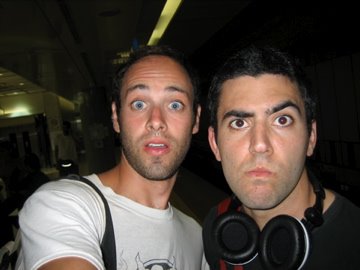
It was at about that time that I saw, peering through the crowd like some sort of creature that peers a phantom. It was a whisper and a rustle, yet somewhere out there, I knew that it lurked. The wily Raccoon (aka Rich, never quite sure about the nickname). He lurched through the crowd, enormous headphones encompassing strangely shaped ears...and then...WEIRD PICTURE TIME!


Much as with my reunion with a long lost friend in India, our reunion was joyous. Quite UNLIKE that reunion, I did not then immediately plop down into a beach chair, take a swig out of an enormous ice-cold beer and watch the sun set. No...Rich had other plans.

"Okay we're meeting about 10 people for dinner in (Unpronounceable japanese) word but first we're going to get tacos and then we're going to a club."

"Uh...okay, but I'm pretty tired, can we call it an early night?"

Rich had neglected to mention to me a number of things. First, he neglected to mention that he had planned a kind of "Welcome to Japan" celebration which included, among other things, eating four or five times with different groups of people. Next, he had neglected to mention that most of our evening would be passed at a club. The real kicker though, was the following:

Norm: So where can I drop my bags?

Rich: in this train locker!

Norm: (listens for crickets chirping...doesn't hear any, apparently they're a delicacy here) Excuse me? where are we staying tonight?

Rich: Ummm (shuffles feet)...we're not...

Norm: (seeing red...) I...haven't slept in like 3 days, and now we're going to be out all night, after I just got off of a 8 hour plane ride, haven't slept and won't be able to shower?

Rich: Yeah.

And so it went. Our first stop was to get me a new t-shirt, since the one I was wearing was now nearly completely invisible. Apparently if you wear something long enough without washing it, it just sort of fades into the ether. (p.s. if you are over 6 feet tall and have blue eyes, please do the kind people of Tokyo a favor and allow those two physical characteristics to be surprise enough. Don't do as I did, which was to remove my shirt in the middle of a crowded store, rip open the package of shirts I've just bought, and then put it on and walk out like nothing unusual had happened. Apparently in a land where giant roving lizards (godzilla is real...REALLY!) are nothing to get all worked up about, a white guy's hairy chest is a real problem. Who knew?

Freshly clothed, we set out to devour some tacos (yes my culinary adventurousness is to be marveled at), prior to going and having a slightly more traditional Japanese meal.

I have previously described the insanity that is India, specifically Mumbai in an earlier post(hyperlink), so I figured that I had seen everything that the masses of humanity could throw at me.

It turns out that I was wrong.


Arriving at Shibuya train station, I emerged into what can only be described as a fully functioning Times Square/Carnival complete with bright blinking lights, freaks of all nature and description, and a small brass bulldog that everything seemed to rotate around.

There are a LOT of people here...


A large, strangely feathered hat must be tipped to the young women who populate Tokyo. I don't personally know much about fashion, but what I do know is that these girls were either so far on the cutting edge of fashion that they were practically bleeding trendy, or they had been dressed by their kindly, senile, blind neighbor who had just retrieved a box of clothing left over from pre-1700 Japan. There is no inbetween. Bright pastels contrasted with alternating black and white striped shirt sleeves, and that was on their legs. Neon jewelry, spiky/swirly mohawks over high ruffled collar shirts and calf-length boots. You could devote an entire book just to describing one clique of kids.


"We represent...the lollipop guiiiiild"


"Wait...we're wearing the school girl stuff? Oh I thought we were doing all black goth gear...shoot!"


"I'll get you my pretty, and your little dog too!" (oh man, two Wizard of Oz jokes in one post...I can hear Judy Garland swimming in her booze soaked grave)


I have. No. Idea.


I've already kind of gone into what that square was like above, but it is hard to capture the essence of the moment accurately. Suffice it to say that seeing that many people assiduously avoiding even the THOUGHT of a jaywalk was a weird experience indeed.

Then, it was time for food.

I have now in my travels eaten bugs, larvae, snake, springbok, crocodile, and any other number of unidentifiable munchable, all of which I have attacked with gusto. Still, there is nothing quite like hearing the words "raw" and "horsemeat" used in conjunction to describe something that someone would like you to raise your eyebrow (get your gander up...whatever euphemism you choose to employ).

Now tell me that doesn't look delicious? "Wilburrrr...NOOO!!!"


Basashi, as it turns out, is not only a delicacy, it is absolutely delicious. It is basically extremely thin strips of raw horse, which you use chopsticks to swirl around in a mixture of horseradish, garlic and soy sauce. Even without the accoutrement's, this was a particularly tasty dish (My apologies to Mr. Ed, Seabiscuit and The Black Stallion).

The place that we ate at is known as an Izakaya, and rather than try to give a verbose and over-long explanation, I will let Rich-san sum it up for you. "This is the Japanese equivalent of a bar except that food plays a much larger role and specific foods are featured that either go specifically well with beer or sake." So there you have it. It's exactly as he said, except that instead of barstools, you sit on little mats on the floor, and instead of ordering from a printed menu of words, I ordered from a menu of enormous colorful pictures (thank god for that, or I would have ended up with octopus heads in a garbage bag with a side of Donkey hair or some other such nonsense...crazy Japanese bars)

After dinner, we ended up at a club...after first being rejected from a different club. We intially went to a club called Harlen (yes, a huge Hip-Hop club in the middle of Tokyo with a HILARIOUS website) where the entire group was massively inconvenienced by my attire: specifically, the fact that I was wearing sandals. Anyone who knows me knows that this was not merely a function of my being on the road, I NEVER wear shoes out. However with my ready-made excuse of "more than one pair of shoes means one more thing for a village kid to try and steal/bargain for, which is why I don't have any", the group moved on to "Atom", where we danced, and, as has been, and remained a continuing theme, local people stared at us while we did our groovy thing.

Stumbling out of the club at around dawn, I decided that sleep must be some weird concept that philosophers argued about but didn't really exist. I felt a decided need to eat brains (or maybe I just looked like a zombie).

I looked at Rich. Rich looked at me.

"Well, it's only 3 hours on a train to my house, and then we have to get a ride there..."

"I hate you."

The train that we rode was the much vaunted Shinkansen, which I believe is Japanese for both "make you go broke" and "screw you, American tourist." Ancient texts tell us that it could alternately be translated as "You honor us with your hard earned money, now please enjoy our whisper-quiet manner of conveyance. Also...now you're broke." It lived upto its billing as a "bullet-train" though, in that it was shaped like a bullet, and was a train. Good stuff.


This is a picture of myself, Rich and the great and powerful Devon who is now devoting his time to teaching our most frustrating of languages to children in China. He is truly a glutton for delicious punishment (and a hell of a writer as well).


Dear rich: Screw you


Dear Norm: Shut up


Dear Abby: so the other day this crush of mine...


Arriving in Nakano, the town NEAR where Rich lives, I availed myself yet again of the opportunity to horrify some Japanese people. As I had been in the habit of eating whatever, whenever I wanted to (oh sweet sweet pad Thai carts in Bangkok...sigh), finding myself short on cash (Tokyo = Bring someone elses credit card), and near starving, I practically dove through the front door of a donut shop (cleverly titled "Mr. Donut"...aparently the Japanese are also fans of the Simpsons) as soon as we stepped off of the train. I quickly scarfed several donuts, then, noticing that there was a garbage can behind the counter, I quickly leaned over the clerks counter and tossed the garbage into the can. It was at that point that Rich grabbed me by the shoulders and practically hauled me out of the store.

Why you ask?

Because the look on the clerks face was roughly what you would get if you crossed the look of being confronted with an 18 foot venomous snake, and a rampaging elephant with a shark on its back. That is, this poor girl was quite scared. Rich slowly explained outside:

Rich: You are dumb. You are 2 feet taller than everyone here, you haven't shaved in a month, you smell like the underside of a particularly dirty mattress and on top of all of that, people here just don't step around/over/through counters.

What can I say...he was 3 for 3, right on all counts. I gently reminded him that I may not have been quite such a horrifying sight if I had been allowed the opportunity to...oh I don't know...SHOWER or SHAVE or SLEEP at some point in the preceding 3 days. Rich dismissed this notion with a rather limp hand wave and a "Bah" which seemed to settle the issue.

Sufficiently rebuked, we rode to Richs house where I slept on a futon for roughly eleventy-billion hours.

(Disclaimer: due to my near-catatonic state, I did not have the wherewithal to take lots of pictures from this first night. Thus, many of the pictures here were not taken by me. I have taken PAINSTAKING measures however (i.e. sort of glanced at them) to ensure that everything you see represented above were sights that I actually was a witness to. Now quit yer griping).

Next: The cool north of Japan, a new teacher, and NINJAS!